


Five minutes to stay informed.
Washington’s “no”
The US formalizes the annual review to 2036
The US formalized on July 1 that it will not extend the USMCA 16 years. The treaty’s middle path kicks in: annual review until 2036. Mexico and Canada signed the extension; Washington did not. The pact stays in force, but loses its long horizon (Investing).
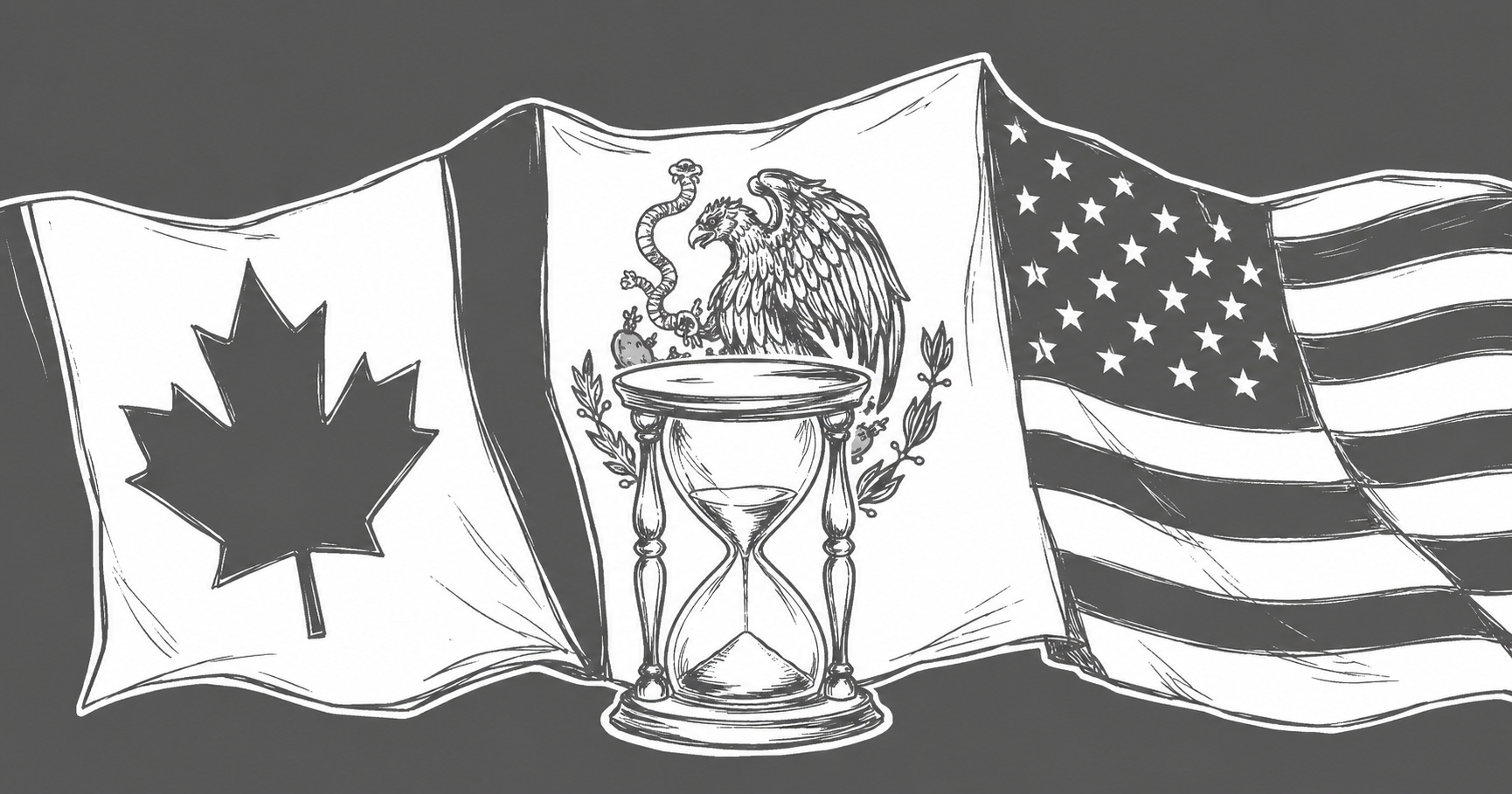
Ebrard took it in “zen mode”: “we’re in no hurry“. Sheinbaum: “it doesn’t mean its disappearance”. True in legal terms —nothing changed on July 2— but the 16-year certainty did die: every anniversary reopens the negotiation (El Financiero, Proceso).
The market had priced it in: the peso slipped only to 17.53 (−0.29%). The damage isn’t the hit, it’s the regime: the annual review becomes a lever Washington can collect every year on autos, steel or energy (Ámbito).
BlackPaper Comment: Extending 16 years would have spent the leverage; the annual review turns access to the north into a subscription Washington renews or not each July. Mexico didn’t lose the treaty: it lost certainty, and with it the investment that can’t live with a yearly reopening.
Morena filters through the UIF
The State’s machinery vets 277 hopefuls
Ariadna Montiel announced on July 1 that Morena‘s candidacies for the 17 governorships in 2027 will pass through a Security Cabinet filter: UIF, SAT and SSPC. Registration closed on June 29 with 277 hopefuls (Infobae).
The party sells it as seeking “better profiles“. But it puts the State’s financial-intelligence and tax organs to vet a party’s aspirants, ahead of September’s polls. Without public criteria, the filter is discretionary (Proceso).
BlackPaper Comment: The same tools —UIF, SAT— that chase fuel theft now sift Morena‘s aspirants. It may be vetting or it may be control: with no published rules, the leadership decides who competes using the State’s instruments, not the party’s.
Remittances shrink
The amount grows; the number of transfers falls
Banxico reported on July 1 remittances of 5,611 million dollars in May, +3.8% annual: the “fourth month of growth” the government touts. The fine print complicates it (El Financiero).
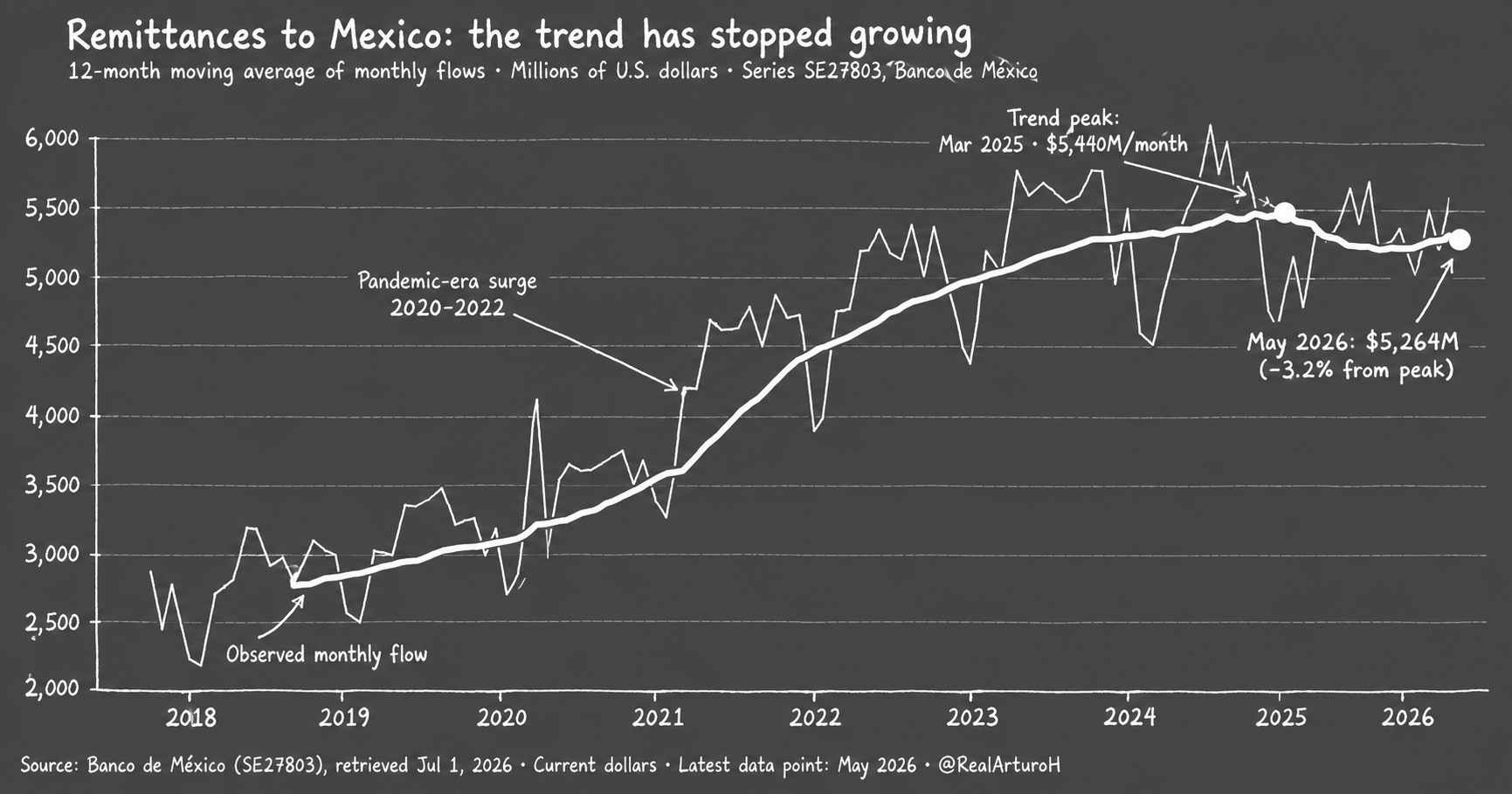
The number of transactions fell 1.7% —13.9 million transfers—; the figure rises only because the average amount grew 5.6% to 404 dollars. Fewer migrants send, and those who do send more. It’s the weakest May since 2015 barring the recent drops (El Financiero).
BlackPaper Comment: The headline celebrates dollars; the data counts people. When the volume of transfers falls and only the average holds the figure up, that’s not strength of family income: it’s a consumption base thinning out, exactly what the domestic economy can’t afford.
Your face, the bank’s key
The CNBV makes facial biometrics mandatory
Since July 1 the CNBV‘s amendment to the Single Banking Rules is in force: mandatory facial biometrics to verify identity on level 3 and 4 accounts and on transfers or withdrawals above 140,000 pesos (Legalario).
The CNBV presents it as anti-fraud armor. But the rule doesn’t clarify whether a client can refuse to hand over a sensitive biometric, and leaves each bank to build its own database, with no single custody regime. A de facto obligation kicks in with no way out (Legalario).
BlackPaper Comment: A State that asks for your face to let you move your money promises to guard it bank by bank, without saying how. Against fraud, fine; but a datum you cannot change —your face— handed over with no opt-out and no single custody shifts the whole risk onto the client.
The north goes dark
CFE promises 244 billion pesos while Nuevo León blockades
CFE gathered 29 states on June 30 and committed 244,000 million pesos in transmission and distribution for 2024-2030. In Nuevo León, six days of blackouts at 47°C triggered nearly 300 protests (El Imparcial).
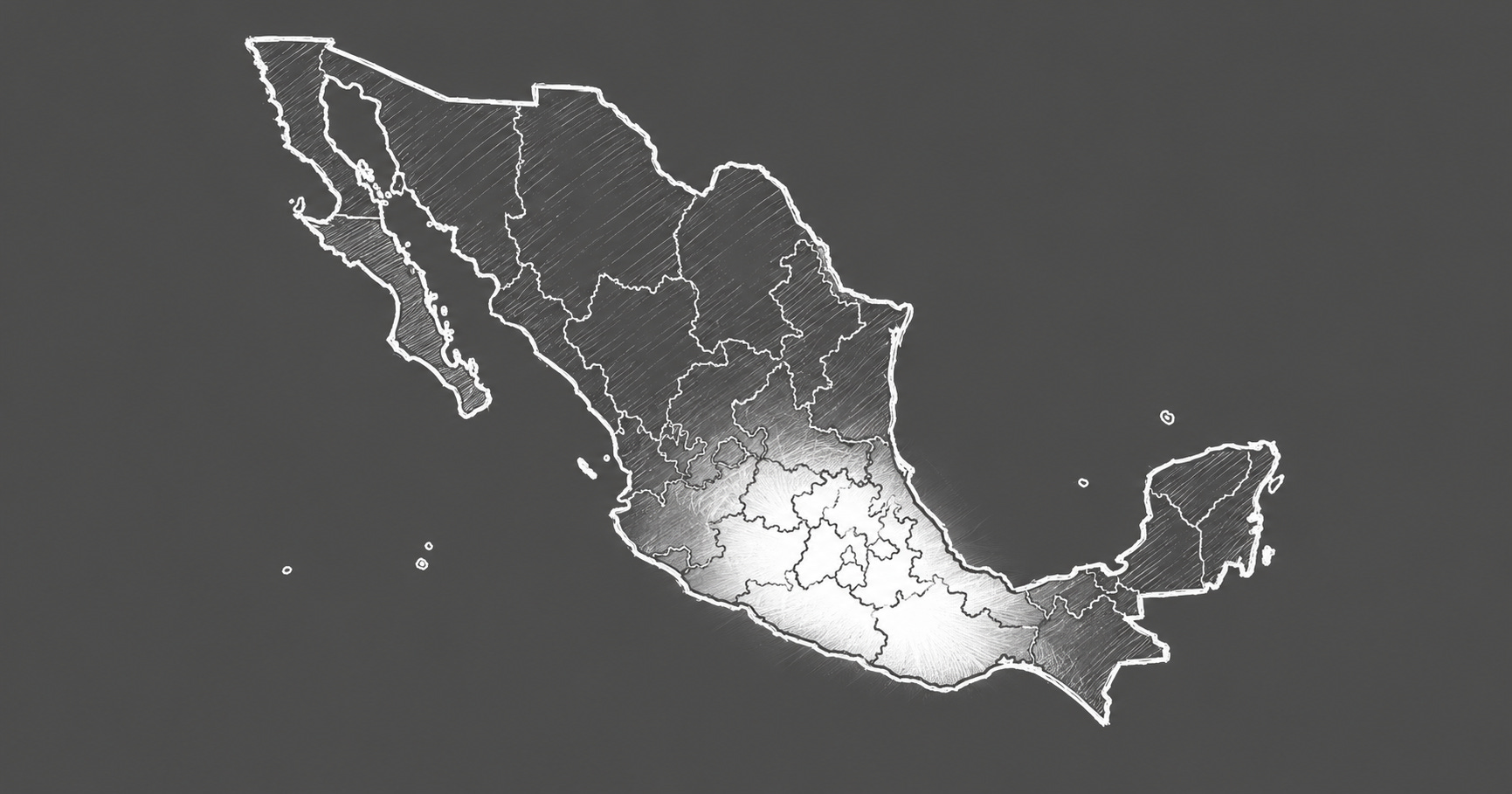
The sum sounds big, but spread to 2030: barely some 15,000 million pesos land in 2025-2026, little against a grid already overloaded by nearshoring demand. The government denies a “crisis“ and blames only distribution (Proceso).
That same June 30, while CFE met about the blackouts, governor Samuel García and his cabinet watched the Netherlands-Morocco match in Monterrey. Nuevo León sells firm power as its nearshoring hook; today it can’t guarantee it (Proceso).
BlackPaper Comment: There’s no nearshoring without power. Promising 244 billion by 2030 doesn’t cool a house at 47°C this summer, nor convince the plant deciding where to land. Firm power was the north’s edge; the blackout turns it into its warning.
Breves
Stocks and forecasts. The IPC lost 1% on June 30 and closed below 67,000 (66,966.68). Banxico’s survey cut 2026 GDP to 1.07% —from 1.44% in March— and inflation to 4.21%; the rate stays stuck at 6.50% (Investing, El CEO).
Crude collapses. Brent closed June near 72.68 dollars, −23.5% on the month —its worst since 2020— on the US-Iran truce and the reopening of Hormuz. Cheaper gasoline, but a hole in the oil revenue of the Budget and Pemex (CNBC).
The Fed with no compass. Kevin Warsh said in Sintra that inflation is still “too high“ and confirmed the Fed drops forward guidance: it will decide data by data. For the peso, more volatility on every US figure; jobs land on July 2 (CNBC).
Four investigations over Reforma. Mexico City’s prosecutor opened four investigations into the deaths by asphyxia at the Mexico-Ecuador celebrations on Paseo de la Reforma; Sheinbaum instructed Segob to support the families (Ámbito).
Colombia closes the Petro era. The CNE proclaimed Abelardo de la Espriella president-elect with 12,960,166 votes to 12,708,312 for Cepeda —a margin of 0.004 points—; he takes office on August 7. A rightward turn that costs Sheinbaum an ally (El Tiempo).
On the radar
Jul 2 — US jobs report; with the Fed off forward guidance, it moves the peso.
Jul 20 — 3rd round of the USMCA: first test of whether the annual review is procedure or weapon.
Jul-Dec — Morena settles its 2027 candidacies; polls in September.
Summer — The north’s power crisis, with 47°C and nearshoring demand on top.