


On June 21, Abelardo de la Espriella beat Gustavo Petro’s left for the presidency of Colombia. He won by little, and the count is still disputed, but his victory closes a pattern that is now hard to deny: since 2023 the right has taken most of the region’s presidential elections. Argentina, Ecuador, El Salvador, Bolivia, Chile, Honduras, and now Colombia.

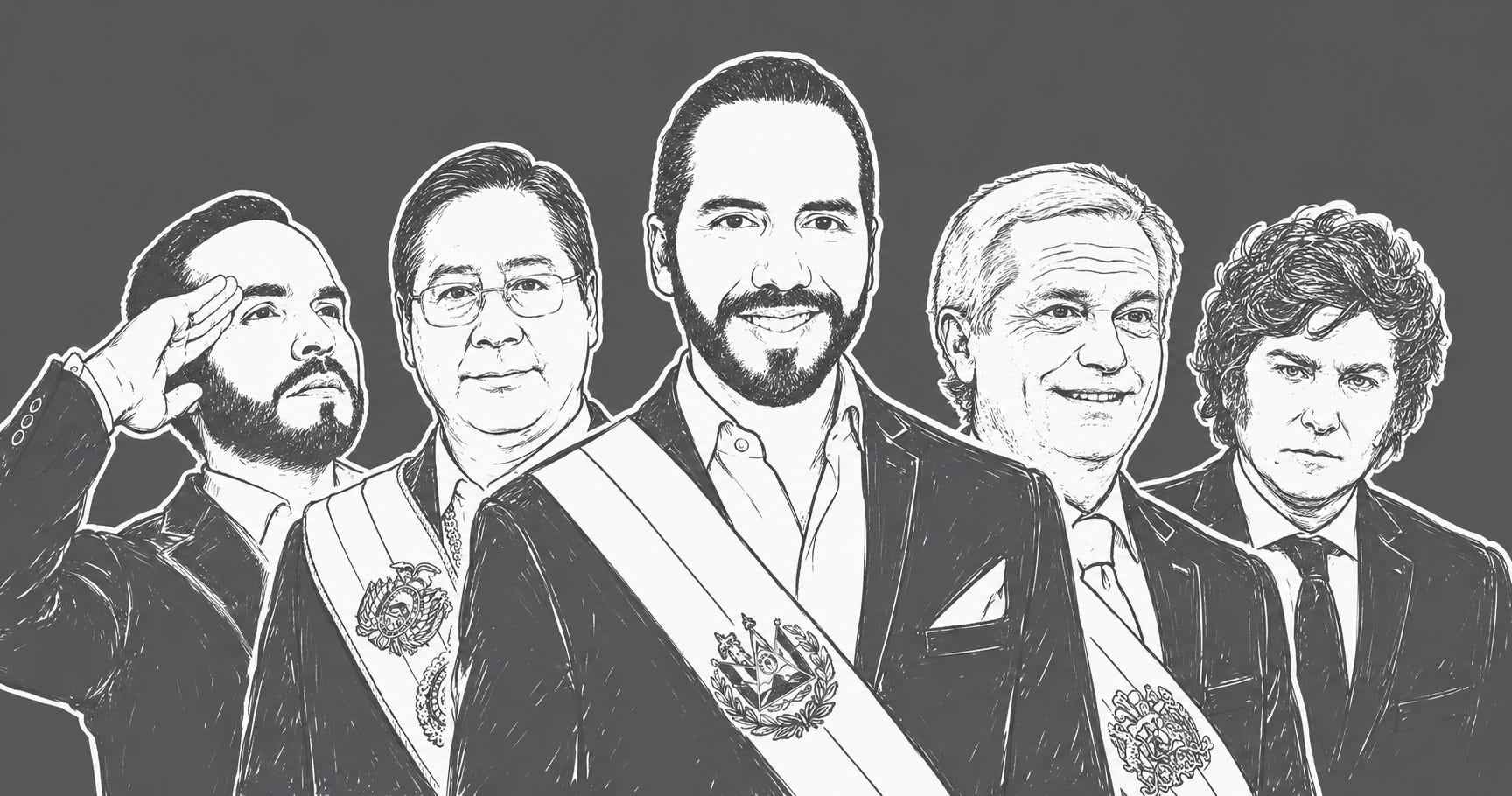
That is not a lucky streak. It is a method, with steps you can name and repeat, and it worked for candidates as different as Javier Milei, Nayib Bukele, and José Antonio Kast. And let’s be clear about it: Abelardo didn’t write it, he inherited it. Bukele supplied the security model and the digital machine; Milei, the outsider who talks to the “casta”, the political class; Kast, the unity of a right that lost divided and won together. De la Espriella put the pieces together and won. We break them down here, with the data from each case, and at the end we translate them to Mexico, where the left stays comfortable while it falls everywhere else.
Step 1. One single problem
The rule sounds obvious and almost no one follows it: pick one problem and never let go of it. A voter under pressure doesn’t process agendas, he processes threats. Talk about ten issues and none stays in memory; talk about one and you force the government to defend itself on the ground the challenger chose.
Abelardo picked security, and he picked it where Petro had already lost. Colombia opened 2026 with close to 27,000 fighters in illegal armed groups, a 23.5% jump in a single year, with kidnappings soaring, according to the Fundación Ideas para la Paz (FIP). The agenda wrote itself. He didn’t invent the problem: he climbed onto the one that already existed and the government couldn’t cover up.
Milei did the same with inflation in Argentina, and Bukele with the gangs in El Salvador. Each one took the wound his government couldn’t hide and made it the whole campaign. What ruins this step is spreading thin across several issues so as not to leave anyone out, or choosing an abstract one, like “democracy” or “the institutions”, which mobilizes analysts but not the voter with fear in his body.
Step 2. The case file, not the adjective
Documenting the failure is the real key to the method, and the one most often neglected. Calling a government “corrupt” or “a failure” is an opinion, and an opinion rebuts itself. The number, the date, the amount, the name don’t rebut, because they come from the state’s own figures.
Petro’s “total peace” was not just an empty slogan: it was a case file. The government spent tens of billions of pesos on talks with armed groups with no security results, while homicides and kidnappings rose and explosive drone attacks more than doubled from one year to the next (Infobae; El Observador). Whoever shows up with those figures doesn’t look like an agitator. He looks like a prosecutor.
There are two ways to wreck this step. One is to exaggerate or invent: a single false figure destroys the whole file and turns the candidate into the liar of the story. The other is to present the numbers as a technical report, cold and faceless. A number convinces when it carries a story: who it happened to, where, and when.
Step 3. The outsider
After proving the government failed, the voter asks a question the outsider answers with his biography alone: why would I hand this over to someone from the same system? The lack of prior office, which the traditional parties sell as a weakness, becomes a credential. “I never ran this disaster.”

De la Espriella is a criminal lawyer. He founded his movement, Defensores de la Patria, just months before the election, with no party and without ever holding public office, and he won with close to 13 million votes (El Tiempo). Milei was a TV economist who had spent years outside professional politics when he branded the entire ruling class the “casta”. Bukele reached the Salvadoran presidency after breaking with the country’s two historic parties.
It pays to read the fine print here, because it is the riskiest step of the method. The outsider who wins is not just any unknown: he knows the problem he promised to solve, and his personal history can survive scrutiny. The fake outsider, the twenty-year party man dressed up as a citizen, fools no one. And the amateur who doesn’t know the subject either loses the moment the debate turns technical.
Step 4. Win the algorithm, not the newscast
Here the right has been getting it wrong for three decades. It still fights for television coverage, when the election is decided on the phone. The newscast selects, edits, and frames; the algorithm delivers straight to millions the newscast never reached, at a fraction of the cost.

Abelardo’s campaign dominated TikTok and Instagram, with creators and influencers amplifying him without central coordination (El Espectador). The reference case is Milei in 2023: his digital team, led by a 23-year-old strategist, carried his videos to a reach his rivals never came near, with most of his followers between 13 and 24 (Infobae). Bukele passed 11 million followers on TikTok and governs by announcing policy on social media before it reaches the cabinet.
The detail few conservative politicians grasp: this isn’t bought, it’s built. Milei spent less than his opponents and crushed them online. The classic mistake is to treat the platforms like a digital newscast, posting press conferences and bulletins turned into images. The second mistake is to outsource everything to an agency that understands neither the candidate nor the politics. Authenticity online shows, and so does the lack of it.
Step 5. Identity
People don’t vote with the head alone. They vote with belonging. A low-cost visual identity turns a passive voter into someone who goes out to convince others, and it strips the rival of any way to refute it without attacking the people who carry it.

De la Espriella put on the Colombian national team’s jersey during the World Cup and asked his voters to wear it on election day. He turned a soccer match into a march, and several players reacted to his win that same June 21 (Semana). The nickname, “El Tigre”, came from the people before any publicist. Milei had the chainsaw: he didn’t explain it, he wielded it, and the object made the argument (CNN).
The identity that works is born from a real trait of the candidate, amplified. The one manufactured in a consultants’ meeting smells like advertising, and the voter senses it. And there’s a limit: a tribe that’s too closed locks in a base but blocks growth toward the voter who isn’t convinced yet.
What the method takes for granted: unity and machinery
Five steps describe how you win the conversation. Two things are missing that the Colombian case takes for granted and that decide the election.
The first is unity. Kast is the best lesson, in two acts: in 2021 he reached the runoff as the top force, but with the Chilean right divided, and he lost; in 2025, with the opposition vote consolidated, he won with around 58% (Diálogo Político). In Colombia, the runoff let the anti-left vote gather behind a single name. That safety net doesn’t exist everywhere, which is why it matters.
The second is machinery. Winning the algorithm produces resonance, not counted votes. Without financing, municipal operators, and poll watchers, the viral phenomenon evaporates on election day. Macron’s first campaign in France is the useful counterexample: he won because he raised a territorial structure in fourteen months, not because he had the best digital aesthetic. Narrative without machinery is expensive noise.
The translation to Mexico
Mexico has all the raw material to apply the method. What it doesn’t have, yet, is someone to use it.
The problem is clear: insecurity. It is the only one that reaches every social stratum, and it is the promise the government broke most, having offered peace under the banner of “hugs, not bullets.” Mexico closed 2024 with around 33,000 homicides, according to INEGI; the national registry of missing persons exceeds 130,000; and extortion hit its highest level in a decade in 2025, at a pace of one victim every few minutes in 2026 (INEGI; COPARMEX).
The case files are plentiful, and all can be documented without a single adjective. The Segalmex embezzlement, with a diversion the Federal Audit estimated in the billions of pesos and dozens of former officials detained (La Silla Rota). Fuel-tax smuggling, with a complaint before the Attorney General’s Office and raids by U.S. authorities in Houston over illegal fuel imports (Azteca Noticias). The flagged asset declarations that don’t add up. And, above all, Pemex: a fiscal black hole of hundreds of billions of pesos that the treasury bails out year after year, hard and audited data (Expansión). All are cases with open investigations; the craft is in reading them aloud, with figure and date, without lowering them to the “institutional” tone that makes them boring.
The outsider doesn’t yet exist with proven viability, but the market for him is huge: nearly four in ten Mexicans say no politician represents them. Today’s names don’t work. Samuel García is a sitting governor, that is, part of the system by definition. Ricardo Anaya carries the stigma of 2018 and embodies the political class the voter already rejected.
The algorithm is wide open. The opposition talks to the newscasts and to its own base, which skews older, and it cedes to Morena the young voter, the one who loses the most under this government and the one who lives on TikTok. Competing there isn’t opening an account and posting bulletins. It’s young talent, short format, and one figure per video.
One caution remains, in the identity step. The thread that ties all the case files together is an uncomfortable question, “where is it?”, which serves equally for the Segalmex money and for the disappeared. But the language of the disappeared belongs to their families. The opposition can walk alongside that grief; appropriating it would cost it dearly and would be wrong.
And here is a fact worth keeping in mind against the idea of an unbeatable Morena: the polls that paint it at 69% or 70% approval come, in large part, from houses close to the government. The independent pollster AtlasIntel put Sheinbaum near 51%. The gap between those numbers isn’t statistical, it’s narrative. And where the opposition truly competes, that narrative breaks: in Coahuila, the PRI beat Morena in all 16 districts of the local Congress, 16 to 0, in a state that hasn’t changed parties in nearly a hundred years.
What’s missing isn’t reason, it’s will
Colombia looked like a lost cause four years ago. Petro won with the banner of change and turned it into a documented failure: more insecurity, more debt, a peace that never came. The right, instead of lamenting, looked for someone who spoke plainly, who owed no favors, who dominated social media, and who put security at the center. And it built the unity and the structure to land that message in votes.
Mexico is no better off than the Colombia of 2022. It has the problem, it has the case files, it has the market for an outsider, and it has the digital ecosystem where the direct format can break Morena’s hold. What it lacks is the unity that the PAN, the PRI, and Movimiento Ciudadano refuse to build, and the machinery that turns noise into votes. The 2027 midterms are the training ground; 2030 is the real fight. The method is in plain sight and it already worked two thousand kilometers away. The rest is a decision.